Full STEEAM Ahead!

Featured

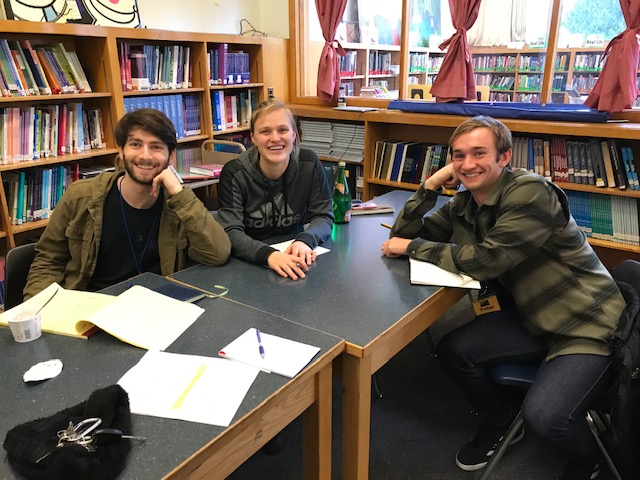
By Colin Cahill (he/him), Paul Lawrence (he/him), and Miche McCall (they/them)

All aboard the STEEAM train! This is a blog to showcase the project of three Oberlin College Students at Eckstein Middle School in Seattle. Our goal is to assist in developing project-based, experiential, and interdisciplinary learning for the students of Eckstein. Over the course of the month of January, we will be working with students, teachers, administrators, and parents, to develop a platform for these ideas to flourish, and conduct research and reporting on how our ideas work in the classroom.

How did three college students from a small liberal arts school in rural Ohio end up teaching in a busy city in the Pacific NW? The answer lies in Oberlin alumnus Jessica Levine. Jessica has been teaching Science and Sustainability in Seattle classrooms for over a decade, earning the Patsy Collins Award in 2016 for Sustainable Education, as well as being a Boeing Centennial Scholar in 2015 (Jessica also has her own blog on sustainability education, check it out here). For the past 6 years, Jessica has been working with Oberlin students during winter term (a month in January where Oberlin Students can pursue an independent research project) inside of her own classroom. However, one of the problems with teaching at Eckstein that could never be solved with a single TA is that teachers can’t get outside their own classrooms enough to communicate with one another. So, starting this year, Jessica has launched, along with the three of us, the STEEAM Eckstein Winter Term Internship. The goal of this internship is to allow Oberlin students to draw upon their unique, interdisciplinary educational experiences and also serve as “pollinators” of the classroom, taking ideas and concepts from one classroom, and bringing them to another.

Over the course of January, we’ll be updating this blog with posts about our work, things we’re learning, projects we’re starting, and all of the weird quotes we hear kids say!

The Science of Dragon-Making Comes to Eckstein

Hello! I’m Alexis (she/her) and I had the pleasure of being this January’s Oberlin intern for Ms Levine’s class. Throughout my time here, I worked closely with Ms Levine and her teaching partner in crime: Ms Hoofnagle, as well as Eckstein’s multitalented librarian Ms Sterling to develop a project that incorporated both science and art. The concept of the project: learn about the connection between gene inheritance and traits by making dragons.

The first part of this project tasked students to use the known genotypes (the combination of gene versions) of two parent dragons to determine the genotype that their own dragon had. In order to simulate the randomness of gene inheritance, students flipped a coin to determine whether they got the dominant gene version or the recessive gene version form each of their parents. Next, students used the genotype of their dragon to determine its physical traits (for example, whether it had a green or grey body, or whether it had a horn or no horn). In order to do this, the students needed to use their understanding of the effect of dominant and recessive gene versions (if their dragon had at least one dominant version, it would have the dominant trait). Students then had the optional challenge of repeating the process by mating their dragon with another student’s to produce an offspring.

Then it came time for the students to use their determined traits to actually create their dragons. In order to introduce this part of the project: Ms Levine and Ms Hoofnagle came up with the idea for me to use my theater experience to make the lesson more memorable. Adorned in a long dress, leather arm wraps, and a cloak, I addressed the class as the Head Dragon Trainer from the faraway Kingdom of Oberlinia, who had come to instruct the students on how to make their dragons. They had four options of increasing difficulties for their final product: a 3D colored dragon from a premade template, a freehand illustration, a moveable cardboard puppet or a stuffed animal. During this lesson, Ms Levine and Ms Hoofnagle mentioned that while this project integrated science and art, it was fundamentally a science project meaning students would be graded on their understanding of the concepts rather than on the artistic quality of their work. As a result, students were encouraged to take risks when choosing which option they would use to make their dragon.

Having chosen what dragon they would make, the Dragon Trainers in Training were ready to get to work the following week. I spent my time helping students who were working on cardboard and stuffed animal dragons in the maker’s space in the library, with the support of Ms Sterling and several extremely helpful adult volunteers. After making their dragon, students also had to complete a “breeder’s statement” which included listing the materials they used in their product and a description of how their dragon inherited a certain trait. We finished the project with a gallery walk (or as Ms Levine called in: A Mendelian Menagerie) in which the students displayed their work and got to see each other’s final dragons. During the walk, the students had to complete a worksheet to reinforce their understanding of the genetic concepts and to reflect on the process of the project. I dressed up yet again as the Head Dragon Trainer and walked around leaving Official Dragon Trainer certificates (generously created by by friend) with personalized comments on the dragons. I was glad to see that many students added creative flair to their dragons to make them even more unique.

This project combined science and art to give students a memorable experience that reenforced what they were learning in class. Ideally, it strengthened the students’ knowledge of how organisms inherit one gene version from each parent and how that determines an organism’s physical characteristics, beyond just learning about it in the classroom. As a bio major (with a bonus love for fantasy roll playing games) I really enjoyed the process of managing this project, helping students create their dragons and seeing everyone’s final products. Attached to this post is a quick video showing highlights of the process, so you can get a sense of the dedication it took for these young trainers to create dragons. 

FIFA as an interdisciplinary learning experience

By Colin Cahill

Video games can be bad. With the increase in mass shootings in the past decade, some of which came from students or young adults with a past of playing violent video games like Call of Duty or Halo, it should come as no surprise that violent video games have been shown to increase aggression in kids, as well as adults. However, of the nonviolent ones to choose from, FIFA, a soccer video game, was always my favorite. I played soccer on school teams and club teams in middle school and high school, and loved playing FIFA with my best friend, who also played a lot of soccer growing up. We came to FIFA because of the fast-paced action of the gameplay, and the flashy tricks and skill moves that you could perform in-game. However, what we learned along the road spanned several subjects, from Geography to Economics.

Soccer, or Fútbol as the rest of the world knows it, spans nearly every country. EA, the maker of FIFA, analyzes and gives stats to the leagues and players they feature in the game so that they can be accurately represented. Through playing FIFA, my friends and I studied geography, learning city names in Europe, South America, Mexico, etc. I doubt many of my fellow 15 year-olds born and raised in Seattle new that Beşiktaş was a city in Turkey, or that Pachuca was the capital of a state in Mexico. We also learned how cities were divided by their soccer teams, how within a city like London supporters were divided in between teams such as Arsenal, Chelsea,Tottenham, and Fulham, and often these inner-city rivalries burned the fiercest.

In FIFA, there was a game mode called Ultimate Team, where players all over the world had virtual “cards” that were bought and sold on a market not unlike the stock exchange. We learned the basics of supply and demand, as the best cards were often released in the least quantity. The game gave you virtual coins for playing games with the teams you built, and those coins could be used to purchase players. We used our knowledge of the market and the desirability of players to buy low and sell high, to build up enough coins to make the best team we could build.

Players in Ultimate Team were sorted by what country they played for internationally, and what professional team they played for. When constructing a team, you had to organize your players in such a way that they were linked to one another via common country, league, or team, so that your team had good “chemistry”. In addition to this, there were different formations to play in where players had different connections. Building teams then became a creative process where you choose a formation and certain players to build the team around, and used a knowledge of players and connections as well as creative problem solving skills to create the best team possible.

I say all of this not to simply say, “Let your kids play video games!”, but to acknowledge that we can learn and make meaning in our learning in a variety of ways. Kids playing video games like FIFA never consider that they’re picking up valuable skills, because their focused on having fun playing the game. They see a problem, say a lack of coins to buy the player cards they want, and they apply their problem-solving skills to solve it in their own way, by learning how to make coins trading player cards. Kids get this opportunity less and less as they get older, as the concept of “play” becomes a childish notion that kids are meant to discard as they grow into adults. But we all need play, something to challenge our minds or our bodies, and something that we can do without the artificial structure of a school surrounding us (although there’s nothing wrong with schools in and of themselves). Play teaches us that we can be learners on our own, and there’s great value in that.

Playing FIFA, I learned skills in Economics, Geography, and Creative Thinking/problem solving. Interdisciplinary learning might be the way I learned in this game, but is also the way that the real world learns. Political scientists have to understand history, politics, and statistics to be effective. Journalists have to have an understanding of the topic they cover (which might shift from job to job), as well as skills in language arts. Sometimes when young learners explore on their own, outside the classroom, they build their skills this way, and in doing so prepare themselves for the real world ahead of them. This is why exploratory, project-based learning is so vital to STEEAM. It gets learners to think outside of any one subject, to learn as they play, and to attach their learning to experiences, as I did in FIFA. If STEEAM is going to innovate education, it has to be built up with engagement in mind; it has to be made like a video game.

Teaching as learning

How teaching can motivate students to be better learners in the classroom

By Colin Cahill

Teaching is the highest form of understanding

Aristotle

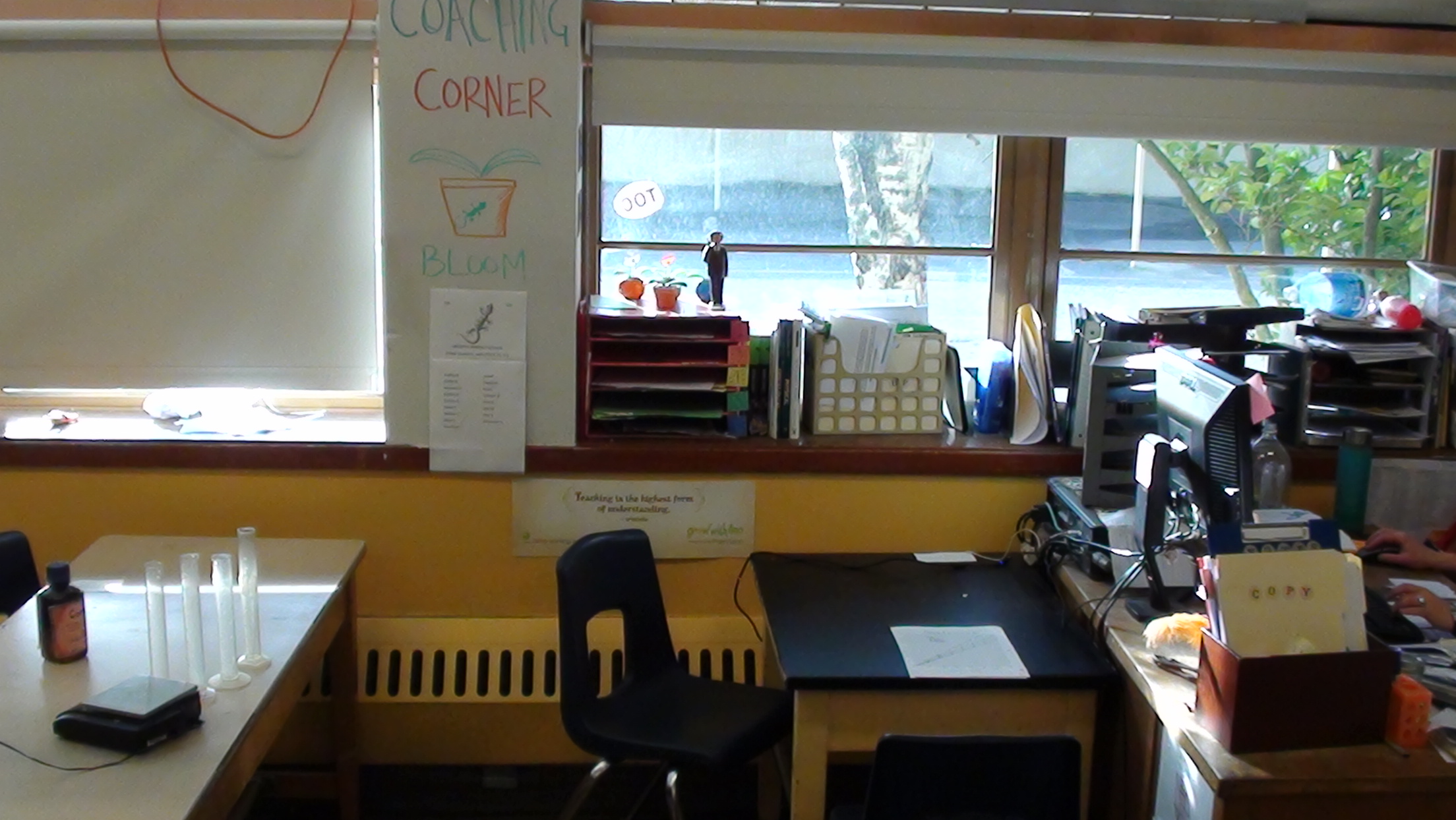
When I came from Oberlin to Eckstein in 2017, I spent the month of January (Oberlin’s winter term) working in Jessica Levine’s 6th-grade science classroom. During that month, additionally, I made a video about an element of the classroom called the Coaching Corner. The idea of the Coaching Corner is fairly straightforward; invite the students who excel in the class become Coaches for the students who are struggling, via this physical space in the classroom called the “Coaching Corner”. What’s so amazing about the Coaching Corner it’s a win-win-win. Jessica (the teacher), with 150 diverse learners to work with, and with a limited amount of time to help those falling behind, has a resource to catch them up. Those students falling behind get an opportunity to practice towards progress, to improve upon their work, and engage with someone else about it in a dialogue. Lastly, the Coaches are engaging with the material in a new way, and also learning how to not just spoon-feed their peers the answers, but to ask questions, and engage in a learning dialogue with their peers.

The last part is important for a number of reasons:

  1. Coaches, because they are the same age as their peers, naturally assume a dialogue, rather than a Banking Education model (See Paulo Freire’s chapter on this in his book, “Pedagogy of the Oppressed”), because unlike most teachers, they see themselves as equals with their peers (this isn’t a dig at teachers I promise)
  2. this dialogue reaffirms the Coaches interest in the subject (if they indeed have any) and reaffirms their affinity for learning through teaching (ever hear: “the best way to learn something is to teach it”?)
  3. When the Coaches begin to learn how to teach, they begin to think about teaching practices, and become more equipped to share in the process of teaching and learning with their teachers

At Oberlin, there’s a program called the Student Teacher Partnership (Originally started at Haverford and Bryn Mawr colleges outside Philadelphia) where interested students audit a class of a professor usually outside of a department they study, and over the course of the semester open a dialogue with that professor about their teaching practices. The program is intended to be non-evaluative, where the student sitting in the class offers their perspective to meet with the faculty member’s perspective. Paul, one of the Oberlin students here at Eckstein with us this month, was involved in the STP at Oberlin and mentioned to me at one point how surprised he was at how teachers were just as insecure and nervous about their own teaching practices as he was in starting this dialogue with the teacher. In the connection of that feeling was where the dialogue begins.

“So what’s the point of your crazy ramblings about dialogue and students teaching?”, you might ask. Well, hopefully, these themes of dialogue, putting students and teachers on a more equitable playing field, and students learning through teaching, say enough about the importance of STP and the Coaching Corner. But to put a statement to my evidence: Offering students the opportunity to do teaching as learning, and to engage with their teachers on a more equitable playing field is the bedrock upon which a learning community and a learning culture is built.

This is not to say building an egalitarian learning culture is easy. Since many students’ first day in any kind of classroom, the notion that the teacher should always be in a position of superior knowledge and power has been demonstrated to us. Students are “taught” that they know nothing, and their teachers know everything. Because even teachers learn this when they are students, this power dynamic is hard to break down. However, in my experience at Oberlin, both partnerships between teachers and students and Coaching Corner-esque opportunities have served to break down this power dynamic.

The first, what in many STEM classes are called OWLS, and in many humanities courses are WA’s or TA’s, are often an effective “version” of the Coaching Corner. These OWLS are students who have already taken the class in question, and work with the professor of the class to produce study guides and help lead students through the class. What I’ve found to be the most helpful are the little things: OWLS describe concepts in a way that is more accessible to me as a college student, and they include memes and silly things in their study sessions that I can personally relate to. Students form connections with their OWLS, and these connections transcend the barrier between teachers and students.

Often the professors I’ve worked most closely with at Oberlin have often done things to break down those barriers as well. One of the most memorable moments of this summer working in a lab, was when someone in our lab remarked, “I love how Professor Belitsky (the head of our lab) always listens to our ideas, even though he has way more experience, he still treats us as intellectual equals”. It’s the small things like that can show students that teachers value them not only as learners but also as collaborators.

My experience at Eckstein watching teachers and seeing firsthand just how much they care and think deeply about the way they teach has invigorated me to come back to Oberlin with a more open mind. To think: how can I start a dialogue with my professors? How can I work to break down these barriers further? I have found that learning about teaching has made me excited to learn (and maybe teach) again.