
How teaching can motivate students to be better learners in the classroom
By Colin Cahill
Teaching is the highest form of understanding
Aristotle
When I came from Oberlin to Eckstein in 2017, I spent the month of January (Oberlin’s winter term) working in Jessica Levine’s 6th-grade science classroom. During that month, additionally, I made a video about an element of the classroom called the Coaching Corner. The idea of the Coaching Corner is fairly straightforward; invite the students who excel in the class become Coaches for the students who are struggling, via this physical space in the classroom called the “Coaching Corner”. What’s so amazing about the Coaching Corner it’s a win-win-win. Jessica (the teacher), with 150 diverse learners to work with, and with a limited amount of time to help those falling behind, has a resource to catch them up. Those students falling behind get an opportunity to practice towards progress, to improve upon their work, and engage with someone else about it in a dialogue. Lastly, the Coaches are engaging with the material in a new way, and also learning how to not just spoon-feed their peers the answers, but to ask questions, and engage in a learning dialogue with their peers.
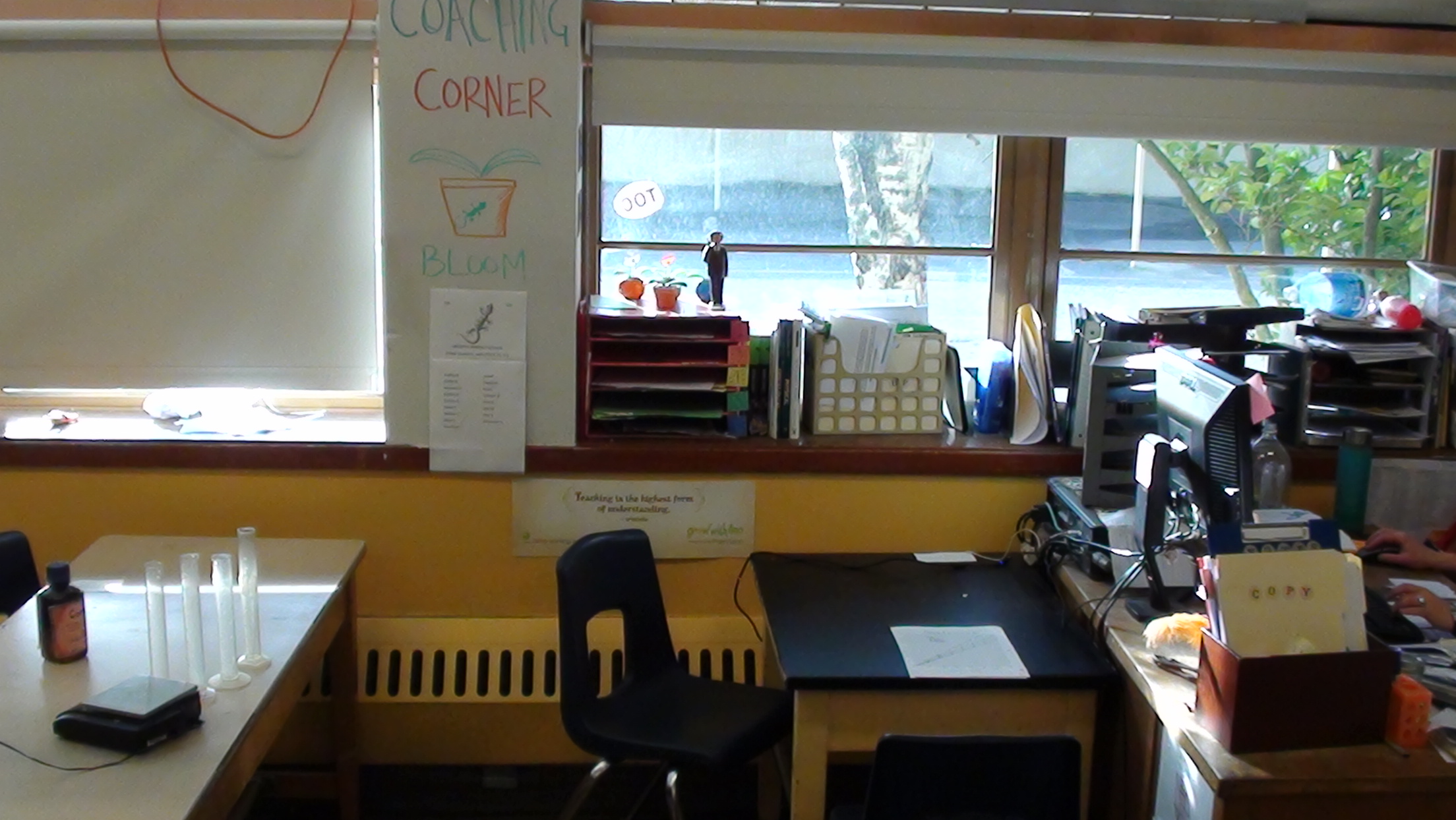
The last part is important for a number of reasons:
- Coaches, because they are the same age as their peers, naturally assume a dialogue, rather than a Banking Education model (See Paulo Freire’s chapter on this in his book, “Pedagogy of the Oppressed”), because unlike most teachers, they see themselves as equals with their peers (this isn’t a dig at teachers I promise)
- this dialogue reaffirms the Coaches interest in the subject (if they indeed have any) and reaffirms their affinity for learning through teaching (ever hear: “the best way to learn something is to teach it”?)
- When the Coaches begin to learn how to teach, they begin to think about teaching practices, and become more equipped to share in the process of teaching and learning with their teachers
At Oberlin, there’s a program called the Student Teacher Partnership (Originally started at Haverford and Bryn Mawr colleges outside Philadelphia) where interested students audit a class of a professor usually outside of a department they study, and over the course of the semester open a dialogue with that professor about their teaching practices. The program is intended to be non-evaluative, where the student sitting in the class offers their perspective to meet with the faculty member’s perspective. Paul, one of the Oberlin students here at Eckstein with us this month, was involved in the STP at Oberlin and mentioned to me at one point how surprised he was at how teachers were just as insecure and nervous about their own teaching practices as he was in starting this dialogue with the teacher. In the connection of that feeling was where the dialogue begins.
“So what’s the point of your crazy ramblings about dialogue and students teaching?”, you might ask. Well, hopefully, these themes of dialogue, putting students and teachers on a more equitable playing field, and students learning through teaching, say enough about the importance of STP and the Coaching Corner. But to put a statement to my evidence: Offering students the opportunity to do teaching as learning, and to engage with their teachers on a more equitable playing field is the bedrock upon which a learning community and a learning culture is built.
This is not to say building an egalitarian learning culture is easy. Since many students’ first day in any kind of classroom, the notion that the teacher should always be in a position of superior knowledge and power has been demonstrated to us. Students are “taught” that they know nothing, and their teachers know everything. Because even teachers learn this when they are students, this power dynamic is hard to break down. However, in my experience at Oberlin, both partnerships between teachers and students and Coaching Corner-esque opportunities have served to break down this power dynamic.
The first, what in many STEM classes are called OWLS, and in many humanities courses are WA’s or TA’s, are often an effective “version” of the Coaching Corner. These OWLS are students who have already taken the class in question, and work with the professor of the class to produce study guides and help lead students through the class. What I’ve found to be the most helpful are the little things: OWLS describe concepts in a way that is more accessible to me as a college student, and they include memes and silly things in their study sessions that I can personally relate to. Students form connections with their OWLS, and these connections transcend the barrier between teachers and students.
Often the professors I’ve worked most closely with at Oberlin have often done things to break down those barriers as well. One of the most memorable moments of this summer working in a lab, was when someone in our lab remarked, “I love how Professor Belitsky (the head of our lab) always listens to our ideas, even though he has way more experience, he still treats us as intellectual equals”. It’s the small things like that can show students that teachers value them not only as learners but also as collaborators.
My experience at Eckstein watching teachers and seeing firsthand just how much they care and think deeply about the way they teach has invigorated me to come back to Oberlin with a more open mind. To think: how can I start a dialogue with my professors? How can I work to break down these barriers further? I have found that learning about teaching has made me excited to learn (and maybe teach) again.
 Full STEEAM Ahead